
Choosing a top real estate developer in Pakistan is the most important decision a property buyer makes, often more important than the plot or apartment itself. A strong developer delivers on time, holds valid approvals and keeps its promises. A weak one can leave you holding a file for a project that never gets built.
This guide profiles the top real estate developers in Pakistan in 2026, covering when each started, what it has built, where it operates, what state its projects are in and what recognition it has earned. It opens with a market overview and our selection criteria so you can judge the names for yourself.
Quick Answer
Pakistan’s most prominent real estate developers are Bahria Town, Defence Housing Authority (DHA), Habib Rafiq Ltd with Future Development Holdings (Capital Smart City), Emaar Pakistan, Blue Group of Companies (Blue World City), Vision Group (Park View City), Gulberg Greens (IBECHS) and Linkers International. They differ in scale, legal standing and delivery record, so buyers should check project approvals and construction progress before investing.
Overview: Pakistan Real Estate Market Valued At Rs. 90 Trillion
Pakistan’s property sector is huge and only partly formal. A report from the Overseas Investors Chamber of Commerce and Industry (OICCI), published in Sept 2026, puts the Pakistan real estate market value at roughly Rs90 trillion, well above bank deposits, the stock market and mutual funds.
Statista is an international data and statistics company that publishes market forecasts across industries. Its estimate covers residential property only, so it is narrower than the OICCI figure. It puts the market at about USD 1.33 trillion in 2025, growing roughly 4% a year to about USD 1.56 trillion by 2029.
Where Pakistan’s real estate market stands now:
- A slow recovery. After years of high prices, high interest rates and uncertain policy, the market is picking up again in 2026. Most of the activity is from people buying homes to live in. Buyers prefer properties they can move into right away and developers with a good track record.
- Higher building costs. Cement and steel have become more expensive, so some developers are delaying new launches. This keeps demand high for existing properties in good locations.
- Money from overseas Pakistanis. Many Pakistanis abroad still choose property as the way to invest the money they send home.
- New rules. In 2022, the SECP (Pakistan’s securities regulator) introduced REIT rules, which make it easier to invest in property through regulated funds. A draft National Housing Policy 2025 would also require new housing societies to set aside 40-50% of their land for apartment buildings.
- Not enough homes. Estimates suggest Pakistan is short by about 20 million homes and needs around 1.5 million new ones every year. These numbers vary by source, so treat them as rough estimates.
How Many Real Estate Developers Operate in Pakistan?
Nobody has an official count. Government documents reported 8,767 housing societies, of which only 2,767 were registered and about 6,000 had incomplete or bogus papers. Those figures are several years old. Separately, a Competition Commission opinion notes about 100,000 registered real estate agents.
According to the OICCI, around 3,000 new construction and real estate companies were registered in Pakistan in FY2023-24, or 10.9% of all new company registrations. That figure covers the whole sector, including contractors, builders, property-service firms and developers, so it does not mean all 3,000 are real estate developers. It does show that the sector draws a steady flow of new entrants, which is why telling credible developers apart matters.
Our editorial estimate is 100-150 organised, corporate-scale developers operating in Pakistan. Alongside them are several thousand small or informal ones.
Why this matters for buyers: A PIDE research note says a typical housing society takes 15–20 years to develop. It also cites anecdotal evidence that many developers fail to deliver. That is why a developer’s track record matters more than a brochure.
How We Selected the Top Real Estate Developers in Pakistan
With thousands of housing societies and developers competing for your attention, a long list of names would not help you decide. So we used one consistent yardstick for every developer in this guide, built around what actually determines whether a buyer’s money turns into a built property. Each name below was judged on the same five points, so you can compare them directly and apply the same test to any developer not on this list.
We looked at five things:
- Project scale and geographic footprint
- Delivery record and construction status
- Regulatory and legal standing
- Independent awards and recognition
- Transparency of payment plans and approvals
The order below reflects scale and footprint, not a paid ranking. Scale is only the first criterion, and it is the easiest one to see. The other four are harder to spot and matter more to your money, so a developer can lead on size and still be weaker on legal standing, or be smaller and stronger on delivery and payment transparency.
Top Real Estate Developers in Pakistan: Detailed Profiles
The developers below are grouped by the kind of project they build, not just by size. We start with the two giants whose land banks define the market, then move to the newer smart-city schemes around Islamabad–Rawalpindi, then to an international brand, and finish with a commercial specialist working inside established addresses.
For each, you’ll find when it started, what it has built, where it operates, the current status of its projects, and any independent recognition. So you can compare developers on the same terms.
- Defence Housing Authority (DHA)
- Started: DHA Karachi began in 1953 as a cooperative housing society for armed forces officers and became a statutory authority in 1980. It started with just 76.2 acres.
- Cities: Karachi, Lahore, Islamabad–Rawalpindi, Multan, Bahawalpur, Quetta, Peshawar and Gujranwala. Each chapter is independently managed.
- Scale: DHA Quetta spans about 10,000 acres and DHA Multan about 9,500 acres in its first phase.
- Status: Operating across many phases. Some joint-venture projects within DHA have run into delivery disputes, such as Creek Marina in Karachi.
- Customers and revenue: Not publicly consolidated.
- Awards: None independently verified.
- Buyer note: Standards and project risk vary by chapter and phase. Third-party commercial projects inside DHA depend on the individual developer.
Investors can consider DHA-approved projects at premium locations in DHA Islamabad, Karachi and Lahore, where developers with clear legal standing build on DHA-approved land.
2. Bahria Town (Pvt) Ltd
- Started: 1990s, founded by Malik Riaz Hussain. Bahria Town Karachi has been developed since 2014.
- Headquarters: Rawalpindi.
- Flagship projects: Bahria Town Rawalpindi/Islamabad, Lahore and Karachi. Bahria Town Karachi occupies over 46,000 acres and has more than 60 precincts.
- Landmarks: Bahria Icon Tower in Clifton, at 300 m, is Pakistan’s tallest skyscraper. The Karachi development also includes a 36-hole golf course and a Hyatt Regency resort.
- Scale: Third-party sources cite about 160,000 employees (2017) and “14 million customers”.
- Status: Operating, but under legal and financial strain. The Supreme Court accepted a Rs460 billion settlement in 2019 over its Malir land. Payment was due over seven years, ending 31 August 2026. In 2023 the court ruled that Bahria Town had defaulted on instalments. In 2025, it was reported Malik Riaz saying that cash-flow problems had severely disrupted operations nationwide.
- Awards: No independently verified major awards found.
- Buyer note: Confirm the approval and legal status of the specific precinct you are considering.
3. Habib Rafiq (Pvt) Ltd (HRL)
- Started: Initially established as a regional construction and engineering firm in 1962.
- Type of company: Pakistani development and construction firm. Third-party write-ups describe it as active in housing, infrastructure and power projects.
- Role in Capital Smart City: Co-developer with FDHL.
- Other projects: Royal Orchard in Multan and other Royal Orchard societies.
- Locations: Islamabad and Multan. Marketing sites also cite residential communities in Sargodha and Sahiwal.
- Certification: HRL holds ISO 9000 certification.
- Awards: No awards found for HRL as a company.
- Buyer note: Ask for documents proving the earlier projects attributed to HRL.
4. Future Development Holdings (FDHL)
- Started: Established in June
- Type of company: A consortium registered under the Companies Ordinance 1984.
- Ownership: A group of China Liaoning International Economic-Technical Cooperation Group Ltd (CLIC) and Engineering Dimensions (Pvt) Ltd (EDL).
- Role in Capital Smart City: Co-developer with HRL and initiator of the project.
- Other projects: Lahore Smart City is credited to FDHL by some sources and to HRL by others.
- Locations: Islamabad and Lahore.
- Awards: No awards found for FDHL as a company.
- Buyer note: FDHL is a consortium, so ask who the legally responsible entity is for the block you are buying.
5. Emaar Pakistan
- Started: Crescent Bay in Karachi launched in 2006. It was part of a US$2.4 billion investment plan in Pakistan.
- Projects: Crescent Bay (Karachi), Canyon Views and The Highlands (Islamabad).
- Scale: Crescent Bay is a 108-acre oceanfront development with about 4,000 apartments planned.
- Status: Canyon Views homes were handed over. Crescent Bay suffered years of delay and disputes with DHA and investors, then resumed. Emaar Panorama and The Views were completed in 2024.
- Awards: No verified Pakistan-specific awards.
- Buyer note: Backing from a listed international parent is reassuring, but Crescent Bay’s history shows delivery still took years.
6. Vision Group (Park View City)
- Started: Vision Group was founded in 2012, Park View City, was launched in 2017–2018
- Projects: Park View City Islamabad and Lahore, Park View Signature Apartments in Gulberg Lahore, and Park View Corporate Tower on Upper Mall.
- Approvals: The Islamabad project is described as CDA-approved in Zone IV.
- Awards: Not verified in available sources.
7. Gulberg Greens (IBECHS)
- Started: The farmhouse scheme was launched in 2005 by the Intelligence Bureau Employees Cooperative Housing Scheme.
- Location: Islamabad, near the Expressway.
- Why it matters: It hosts many commercial and residential towers by third-party developers, including several Linkers projects.
- Status and awards: Operating and built out in parts. No verified awards.
8. Linkers International
- Started: 2016.
- Locations: DHA Phase 1 Islamabad/Rawalpindi, Gulberg Greens and Wah Cantt. The head office is at Pearl Business Center, DHA Phase 1.
- Projects: Commercial: 27 Arclink, Aurum Orchard, Pearl Boulevard and Pearl Business Center. Delivered or earlier: Pearl Heights, Gulberg Nova, Corporate One and Tower 81. Residential: Zenith by Linkers.
- Scale: The company has delivered 7+ projects and has 4 current developments in DHA Rawalpindi.
- Differentiators: Linkers introduced Pakistan’s first construction-linked payment plan. It also offers real-time construction-site access for investors.
- Awards: International Property Awards 2025 and 2026 with 5-star Asia Pacific ratings, for the commercial project 27 Arclink and the residential project Zenith by Linkers.
- Buyer note: Review approvals and site progress yourself.
9. Imarat Group
- Started: 2016-2017
- Type of company: A UK-based private property development group with subsidiaries in the UK and Pakistan.
- Leadership: Chairman Shafiq Akbar.
- Locations: Islamabad and Rawalpindi, mainly along the Islamabad Expressway and around GT Road, Bahria Garden City and G-11.
- Total projects: 15 projects in Pakistan. The group also says it completed more than 55 remodelling and development projects in the UK.
- Key projects:
- Mall of IMARAT (formerly Mall of Arabia): twin 12-storey towers on Islamabad Expressway, with a CDA NOC.
- IMARAT Downtown / Business District: The flagship mixed-use development, about ten minutes from Zero Point.
- IMARAT Residences: Micro-apartments in the Business District, described as CDA-approved.
- Golf Floras and Golf Floras II: Luxury apartments in Bahria Garden City.
- Others: Amazon Outlet Mall, Florence Galleria, IMARAT Builders Mall and the Hospitality Towers.
- Scale and value: delivered projects worth Rs75 billion in five years and is starting new projects worth US$1 billion. 70+ offices nationwide.
- Awards: No independent awards.
10. Zameen Developments
- Started: 2016–2017
- Type: Pakistan-based real estate development company and sister concern of Zameen.com.
- Leadership: Zeeshan Ali Khan.
- Locations: Lahore, Islamabad, Rawalpindi and Multan.
- Portfolio: 16 projects listed under Zameen Developments.
- Key Projects: Zameen Ace Mall, Mall 35, Zameen Aurum, Zameen Jade, Zameen Phoenix, Zameen Vault, Zameen EON, Zameen Quadrangle and Zameen NEO.
- Focus: Residential, commercial, mixed-use and hospitality developments.
- Scale: Portfolio includes high-rise apartments, offices, retail spaces and mixed-use projects across major Pakistani cities.
- Awards: No independent awards listed without specific verification.
Read together, the profiles show that no single developer leads on every criterion. The largest footprints come with legal or delivery questions, the newer schemes depend heavily on approvals, and the smaller specialists can be stronger on awards and payment transparency.
That is why the same two checks apply whichever name you consider: confirm the approvals yourself, and look at what has actually been built. The comparison table that follows puts all eight side by side so you can see those trade-offs at a glance.
Key Factors to Check Before Choosing a Developer
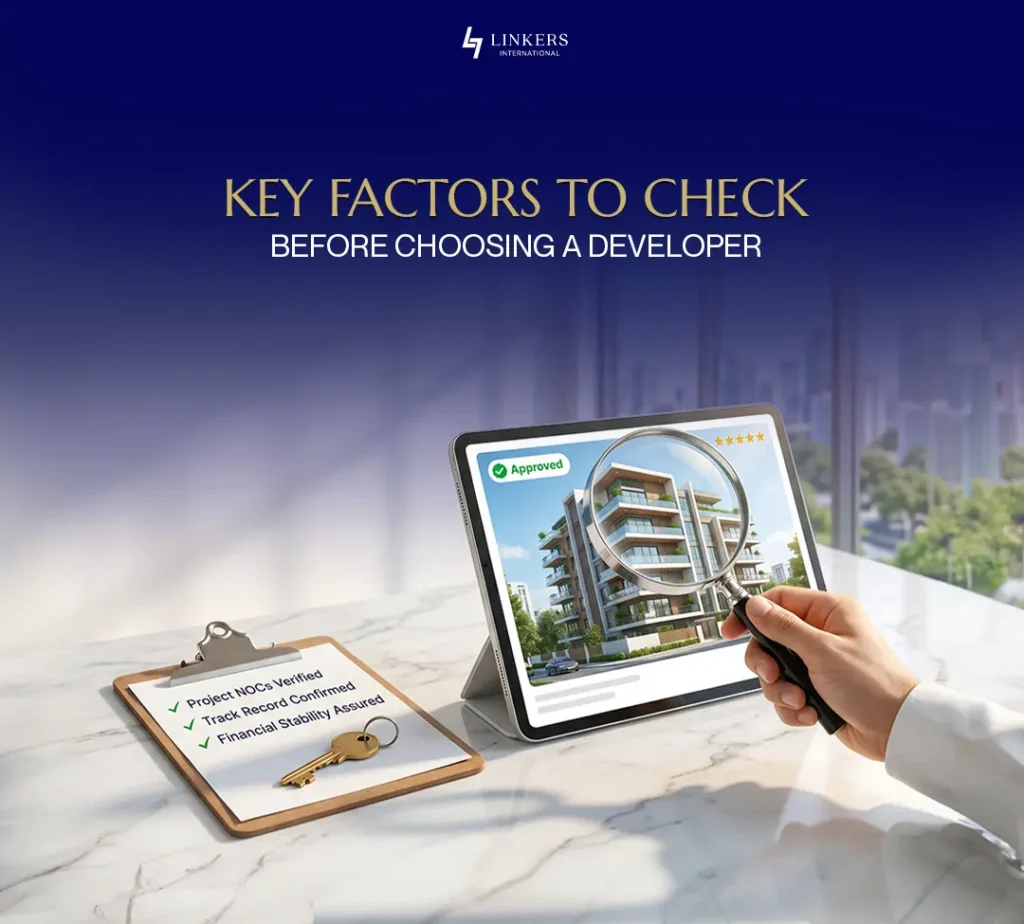
Everything in this guide comes down to one practical question: how do you know a developer will deliver? Developer profiles, awards and market figures can help you shortlist, but none of them replaces your own checks.
The list below turns what we have covered into five things you can verify yourself for any developer, whether or not they appear in this guide. Most of them cost nothing to check, and skipping them is how many buyers end up with a file instead of a property.
- Legal approvals. Verify the NOC, layout plan and LOP with CDA, RDA or the relevant authority.
- Delivery history. Visit completed projects, not only the ones still being sold.
- Payment structure. Construction-linked plans reduce risk.
- Litigation. Search court and regulator records for cases against the developer.
- Location and infrastructure. Motorway, airport and ring road access drive long-term value.
Red flags to watch for:
- Advertising or selling before approvals exist
- Reluctance to show approval letters or site maps
- Payments requested to personal accounts
- Pressure to buy quickly because of a “limited-time” launch
- No visible construction progress on sold phases
No single check is enough on its own. A developer can have valid approvals and a weak delivery record, or a strong record and a risky payment plan, so look at the whole picture before you commit. If a developer hesitates to answer any of these points, or the red flags start to add up, treat that as useful information and be prepared to walk away.
Final Thoughts
Good developers expect these questions and can answer them with documents and site visits. The FAQs below answer some of the most common questions buyers ask when they put these checks into practice.
Pakistan’s developer landscape spans army-backed authorities, private mega-developers, joint ventures and newer commercial specialists. Scale doesn’t guarantee safety, so verify approvals, delivery history and legal standing before you commit. Linkers International is a newer entrant, active since 2016, with recent international awards and a construction-linked payment model.