
The Rawalpindi Ring Road project has entered the final stage of development after years of planning, revisions, and construction. The approximately 38.3–38.6-kilometre controlled-access corridor is designed to connect Baanth on GT Road with the Thalian/M-2 side, creating an alternative route for regional traffic and reducing pressure on major roads within Rawalpindi.
The main road infrastructure is substantially complete, but the project has not yet fully transitioned into normal public operation. In July, officials reported around 98% physical completion, with the toll plaza and some finishing works among the remaining components.
A separate Thalian Interchange project is also being progressed, meaning the full motorway connection envisioned in the final configuration is still evolving.
Rawalpindi Ring Road Latest Update 2026

The most important question for residents, commuters, businesses, and property investors is simple: What is the current status of Rawalpindi Ring Road?
The latest reported position is:
- Main carriageway: Substantially complete
- Length: Approximately 38.3–38.6 km
- Design: Six-lane controlled-access road
- Major interchanges: Baanth, Chak Beli Khan, Adiala and Chakri substantially completed
- Toll plaza: Installation reported as the remaining major component in July
- Thalian Interchange: Being handled separately and expected to proceed as a subsequent project
- Executing agency: Rawalpindi Development Authority (RDA)
- Main contractor: Frontier Works Organisation (FWO)
- Reported project cost: Around Rs47 billion, with a revised PC-I of Rs46.64 billion reported in June
- Latest reported physical progress: Around 98% in Aug 2026
The Rawalpindi Ring Road is expected to become operational on August 14, 2026, marking a major milestone for the long-awaited infrastructure project. With the main construction substantially complete, the opening is set to improve regional connectivity, ease traffic congestion, and strengthen access between GT Road, Rawalpindi, and the M-2 motorway corridor.
This makes it important to distinguish between construction completion and opening for general traffic. A road can be physically complete while still requiring safety, tolling, traffic-management, inspection and administrative arrangements before it becomes fully operational.
What Is the Rawalpindi Ring Road Project?
The Rawalpindi Ring Road is a major infrastructure project intended to create a high-capacity bypass around the built-up areas of Rawalpindi.
Instead of forcing every vehicle travelling between GT Road, western Rawalpindi, the Chakri side and the motorway network to pass through congested urban routes, the Ring Road provides a dedicated corridor around the city.
The current project is approximately 38.3 kilometres long, with a planned six-lane controlled-access configuration, a 90-metre right of way, and a design speed reported at around 120 km/h. The route includes multiple interchanges, bridges, underpasses and other supporting infrastructure.
The project has also gone through a long and complicated history. An earlier Ring Road proposal envisaged a significantly longer alignment, but the route was subsequently revised. The current alignment received its foundation stone in 2022, while construction under the revised project proceeded from 2023.
Rawalpindi Ring Road Route: Baanth to Thalian
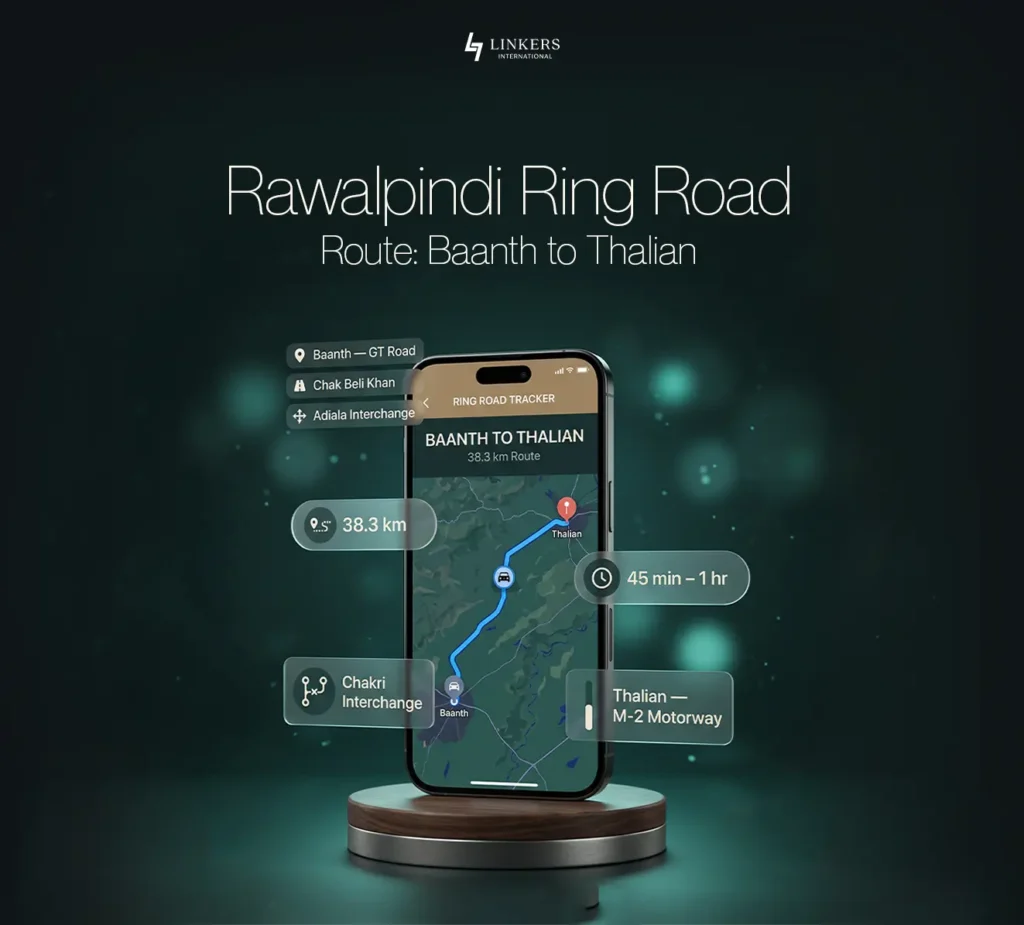
The Rawalpindi Ring Road route extends approximately 38.3 kilometres from Baanth on GT Road to the Thalian side near the M-2 Motorway, creating a strategic connection around the outskirts of Rawalpindi. The route passes through key areas and connects major road networks through interchanges, including Chak Beli Khan, Adiala and Chakri.
By providing an alternative route for commuters, freight, and regional traffic, the project is expected to improve connectivity between Rawalpindi, Islamabad, GT Road, and the motorway network while reducing pressure on major urban roads.
Key connections include:
1. Baanth Interchange
Baanth serves as the connection with GT Road, making it one of the most important access points to the Ring Road. It provides a strategic connection for traffic entering the Ring Road from the GT Road side and is expected to become particularly important for vehicles travelling toward the western side of Rawalpindi.
2. Chak Beli Khan Interchange
The Chak Beli Khan interchange connects the Ring Road with the surrounding road network and provides access to areas along the Chak Beli Khan corridor. Its importance extends beyond commuters because improved road access can make surrounding land more attractive for residential, commercial and logistics activity.
3. Adiala Interchange
The Adiala connection provides access toward the Adiala Road area and surrounding communities.As connectivity improves, areas previously considered relatively peripheral can become more accessible to employment centres, commercial zones and major highways.
4. Chakri Interchange
The Chakri interchange is strategically important because of its relationship with the western side of Rawalpindi and the broader motorway network.It can also support future commercial and logistics development as traffic volumes increase along the corridor.
5. Thalian Interchange
The Thalian Interchange is particularly significant because it is intended to provide a direct connection between the Ring Road corridor and the M-2 Motorway. However, it is important not to present the Thalian Interchange as already complete. Recent reporting indicates that it is being treated as a separate project and is expected to proceed after the main Ring Road opens.
Rawalpindi Ring Road Interchanges and Connectivity
The value of a ring road is not simply determined by its length. Its real impact comes from where it connects. The Ring Road links several important corridors around Rawalpindi, allowing traffic to move between major roads without entering the most congested parts of the city.
This can be particularly important for:
- Heavy vehicles
- Intercity traffic
- Logistics and freight movement
- Commercial transportation
- Daily commuters travelling between peripheral areas
- Businesses dependent on reliable road access
The project’s controlled-access design also means that traffic will enter and exit through designated points rather than through frequent urban intersections.
Rawalpindi Ring Road Property And Economic Impact

The long-term economic impact of the Ring Road could extend beyond traffic. Major road infrastructure often changes the economic geography of a city. Land that was previously considered distant from major commercial routes can become more strategically located once connectivity improves.
For Rawalpindi, this could create opportunities for:
- Industrial development
- Warehousing and logistics
- Retail and commercial centres
- Hospitality
- Fuel and service facilities
- Residential communities
- Mixed-use developments
- Agricultural-to-commercial land transition
The Punjab government has also moved toward establishing industrial estates along the Ring Road corridor, adding an economic-development dimension to the project.
Another major search intent surrounding the project is “Rawalpindi Ring Road property prices” or “Rawalpindi Ring Road impact on real estate.”
The relationship between infrastructure and property values, however, should be understood carefully.
A Ring Road does not automatically mean that every nearby property will increase in value. The strongest impact usually occurs where three factors come together:
Connectivity + Development Potential + Actual Demand
Areas close to functioning interchanges can become more attractive because residents and businesses gain easier access to major roads.
For residential developments, improved accessibility can make commuting easier. For commercial projects, increased visibility and traffic can support customer access. For logistics and industrial land, proximity to major transport corridors can be particularly valuable.
However, investors should evaluate each location independently rather than purchasing property solely because it is marketed as being “near Ring Road.”
Which Areas Could Benefit From Rawalpindi Ring Road?

The impact will likely vary according to distance from the road and, more importantly, distance from an interchange.
Areas around:
- Baanth
- Chak Beli Khan
- Adiala Road
- Chakri
- Thalian
- Rawat and surrounding GT Road corridors
Could experience increased development interest as connectivity improves. But proximity alone is not enough. Investors should also examine approved access roads, development status, utilities, NOCs, existing population, commercial activity and future infrastructure before making an investment decision.
Rawalpindi Ring Road and Thalian Interchange: What’s the Difference?
This is an important distinction for anyone researching the Rawalpindi Ring Road latest update. The main Ring Road and the Thalian Interchange should not be treated as exactly the same construction package.
The main Ring Road corridor has reached the final stages of completion, while the broader Thalian Interchange is being developed separately. Recent reports indicate that the Thalian Interchange’s design and scope changed during the project’s development, increasing its estimated cost and affecting the timeline. The interchange is now expected to be taken forward as a separate project.
For investors and businesses, this distinction matters because “Ring Road completed” does not necessarily mean that every element of the ultimate motorway connection is complete.
Rawalpindi Ring Road Project Cost
- The cost of the project has changed considerably over its development period because of revisions, land acquisition, design changes and other factors.
- Recent reporting places the project cost at approximately Rs47 billion, while a revised PC-I of Rs46.64 billion was reported as approved in June 2026.
- Earlier figures reported during different stages of the project were lower, which is why older online articles may show different project costs.
- For readers searching “Rawalpindi Ring Road cost”, the most relevant figure is therefore the latest revised project cost rather than an older estimate.
A Futuristic Transport Corridor
The Rawalpindi Ring Road project has moved from a long-discussed infrastructure proposal to a nearly completed transport corridor. With the main carriageway substantially finished, the focus has shifted toward final works, tolling arrangements, traffic management and the next stage of the Thalian connection.
For commuters, its biggest promise is better connectivity and reduced pressure on urban roads. For businesses, it could improve access to customers, suppliers and regional transport networks. And for the property market, it could create new development corridors around strategically located interchanges.
However, the real impact will become clearer only after the road is operational and surrounding infrastructure begins developing around it.