
Islamabad, once celebrated for its forested Margalla foothills, natural springs, and relatively abundant water resources, is now facing increasing pressure on its groundwater. Erratic rainfall, declining recharge, growing demand, and pressure on water sources such as Simly Dam and Khanpur Dam highlight the need for more sustainable water management.
So, which trees increase ground water level, and which trees consume more water? While trees alone cannot solve Islamabad’s water crisis, the right native species can support groundwater recharge by improving soil structure, reducing surface runoff, and helping rainwater infiltrate deeper into the ground. At the same time, water-intensive species such as eucalyptus can consume substantial amounts of water, making species selection important for water-conscious landscaping and urban planning.
Alongside rainwater harvesting, recharge wells, permeable surfaces, and better water management, planting native, water-efficient trees can be part of a long-term strategy to protect Islamabad’s groundwater.
What is Groundwater Recharge?

Groundwater recharge is the natural process through which rainwater and surface runoff infiltrate the soil and replenish underground aquifers. These aquifers are Pakistan’s primary source of water for agriculture, drinking, and industry.
However, in urban areas like Islamabad, concrete surfaces and poor drainage systems cause rainwater to flow away often into drains and rivers before it can seep underground.
Did You Know?
- Pakistan wastes up to 60% of its rainwater annually due to rapid surface runoff and poor absorption (WWF-Pakistan).
- Islamabad receives over 1,200 mm of rain annually, but only a small fraction is absorbed into the ground.
- Uncontrolled borewell use in Islamabad has led to groundwater levels dropping by 1–2 meters annually in certain sectors.
This is where trees come in.
How Trees Help in Groundwater Recharge
Water Retention & Infiltration
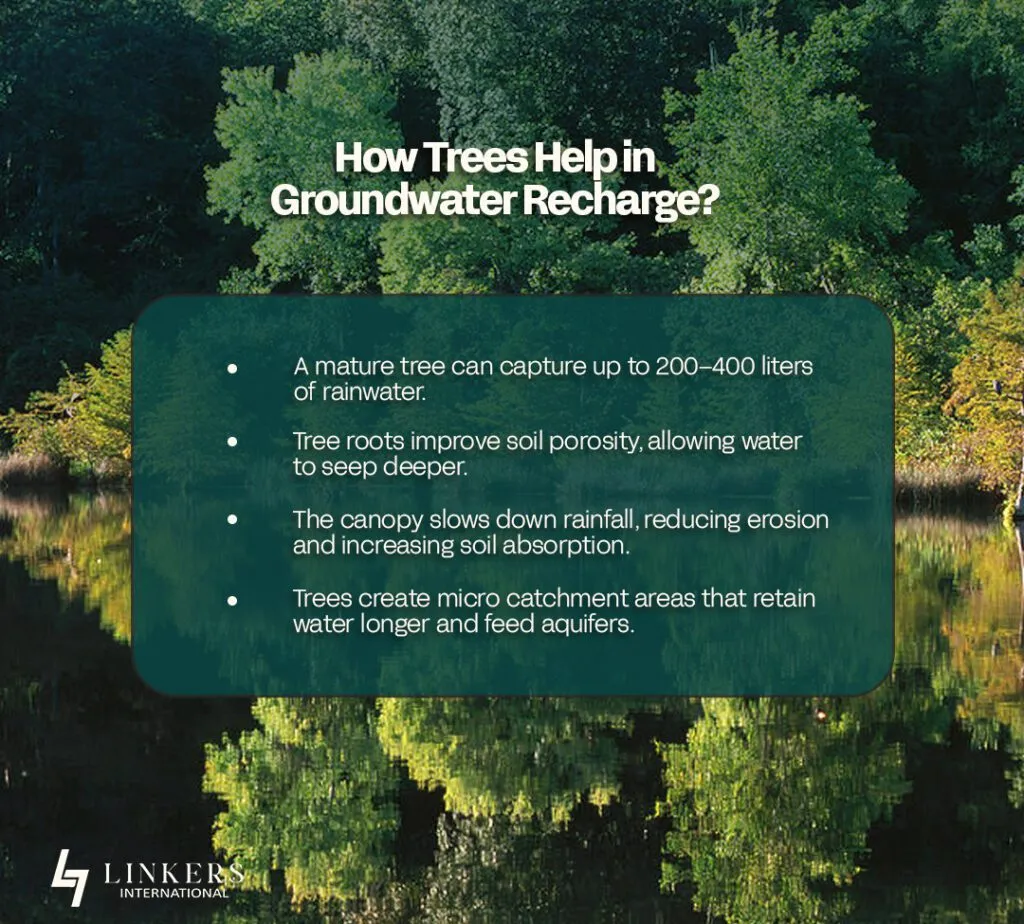
- A mature tree can capture up to 50–100 gallons (200–400 liters) of rainwater in its canopy and root zone during a rain event.
- Tree roots improve soil porosity, allowing water to seep deeper rather than run off the surface.
- The canopy slows down rainfall, reducing erosion and increasing soil absorption.
- Trees create micro catchment areas that retain water longer and feed aquifers.
How Much Water Does a Tree Save?
- According to the US Forest Service, one mature deciduous tree can intercept up to 7,000–10,000 liters of water annually.
- In India’s Rajasthan desert, native tree planting helped increase soil moisture levels by up to 30% in degraded lands.
Case Study: How Tree Plantation Improved Groundwater in India
Reviving the Aravallis in Rajasthan
When asking which trees increase ground water level, it is important to look beyond individual tree species and understand how forests, vegetation, and healthy soils work together to improve groundwater recharge.
In India, a major afforestation program in Alwar District, Rajasthan one of the driest regions focused on planting native species like Neem, Babool, and Ber.
- Within 5 years, villages that once had dry wells saw water levels rise by 2–3 meters.
- Local check dams and tree planting together recharged aquifers and brought back farming in once-abandoned lands.
- The program was led by community activist Rajendra Singh, who won the Stockholm Water Prize in 2015 for this effort.
This model is highly replicable in the Potohar and Margalla regions of Pakistan.
Why Islamabad Needs These Trees Now

In 2024, Islamabad faced record summer temperatures of over 47°C, drying up open water sources and stressing the already strained municipal supply. As the city expands, concrete and asphalt are replacing natural recharge zones.
Strategic plantation of groundwater-positive species can restore percolation capacity in:
- School and university campuses
- Commercial green spaces
- Public parks and buffer zones near dams
- Margalla foothill reforestation zones
- Rainwater harvesting sites
Top Trees That Promote Groundwater Recharge in Pakistan

When exploring which trees increase ground water level, the choice of species matters, but so does the environment in which they are planted. In Pakistan, native and climate-suitable trees can help improve soil structure, slow down rainwater runoff, and allow more water to infiltrate into the ground. The following trees are among the options worth considering for supporting groundwater recharge and improving long-term water retention.
1. Sheesham (Dalbergia sissoo)
Best for: Parks, canal sides, rural roads
- Deep-rooted and resilient, ideal for the subcontinental climate
- Enhances infiltration by improving subsoil structure
- Common along Punjab’s canal belts
- Provides shade, prevents erosion, and yields quality timber
Sheesham is one of the water retaining trees, when you look for which trees increase ground water level as it comes to increase underground water level. Its deep roots not only support the tree in arid zones but also break compact soil layers, allowing rainwater to percolate efficiently. It’s a preferred species for large-scale roadside or canal-side plantations in Punjab.
2. Neem (Azadirachta indica)
Best for: Urban spaces, streets, gardens
- Requires minimal water once established
- Naturally improves soil health and porosity
- Acts as an air purifier and helps in urban cooling
- Supports biodiversity and naturally resists pests
Neem is also well-known for its drought resistance and multiple ecological benefits. In urban areas like Islamabad, its role in absorbing heat, purifying the air, and supporting soil health is vital. It thrives in tough conditions and is ideal for community-driven greening programs.
3. Beri (Ziziphus mauritiana)
Best for: Dry areas, village landscapes, agroforestry
- Thrives in arid and semi-arid zones
- Deep taproot system supports percolation
- Produces fruit and attracts pollinators
- Prevents soil erosion during rains
Beri trees are perfect for Pakistan’s drier areas, where water is limited but land degradation is a concern. The tree’s structure enables it to draw and retain water from deep soil layers, and its fruits offer an added economic and nutritional benefit.
4. Kikar / Babool (Vachellia nilotica)
Best for: Marginal lands, saline areas, natural fencing
- A hardy native tree with widespread horizontal roots
- Stabilizes soil in degraded or saline areas
- Reduces runoff in dry and sloped terrains
- Effective in rainwater harvesting zones
Babool is one of the toughest trees suited to Pakistan’s harsher climates. Its ability to grow in neglected lands and contribute to moisture retention makes it an underrated hero in groundwater recharge efforts, especially in the Potohar region.
5. Amaltas (Cassia fistula)
Best for: Aesthetic avenues, green belts
- Visually appealing with bright yellow blooms
- Attracts bees and enhances microclimates
- Leaf litter improves soil absorption capacity
- Moderate water use, good for urban forest plans
Amaltas brings visual charm and ecological value. Its seasonal leaf shedding helps build organic matter in soil, boosting infiltration. While more decorative in appearance, it still plays a strong functional role in cities like Islamabad.
Complementing Nature with Smart Policy
We cannot plant our way out of the water crisis alone. But with policies that combine:
- Native tree plantation
- Urban rainwater harvesting
- Permeable paving in city planning
- Community awareness
we can extend the life of our underground aquifers, especially in Islamabad where every drop counts.
A Call to Action for Builders, City Planners & Citizens
If you’re a real estate developer, architect, CSR head, or concerned citizen, start including trees with ecosystem value in your planning and plantation drives. Don’t just go for beauty. Go for resilience.
- Choose native, deep-rooted species
- Plant where water needs to go into the ground
- Reclaim Islamabad’s ecological balance
Let’s make Pakistan’s cities greener, not just for aesthetics, but for survival.
Water-smart architecture can play an important role in reducing pressure on groundwater by designing buildings and landscapes to capture, reuse, and naturally infiltrate rainwater. Features such as rainwater harvesting systems, recharge wells, permeable pavements, green spaces, bioswales, and water-efficient landscaping can slow runoff and allow more rainwater to enter the soil. In areas such as Islamabad, combining these strategies with suitable native trees can create developments that use water more efficiently while supporting natural groundwater recharge.
Frequently Asked Questions
Which trees consume more water in Pakistan?
Fast-growing trees such as Eucalyptus, Poplar, and some varieties of Willow can consume significant amounts of water, particularly where groundwater is readily available. Their suitability depends on local soil, rainfall, and water availability, so they should not automatically be considered the best choice for water conservation.
How can I increase underground water levels in Pakistan?
The most effective approach is to increase groundwater recharge rather than simply planting trees. Rainwater harvesting, recharge wells, infiltration ponds, permeable surfaces, check dams, and protecting open soil can help rainwater seep into the ground. Planting suitable native trees and vegetation can also improve soil structure and reduce runoff.
Which root systems can get water from deep underground sources?
Trees with deep and extensive root systems can access moisture from deeper soil layers. Examples found in Pakistan include Neem, Acacia/Kikar, and some native Prosopis species. However, a deep-rooted tree does not necessarily increase groundwater; it may simply access water that is already underground.
What are water retaining trees?
There is no tree that literally “stores” large quantities of groundwater. Trees such as Neem, Kikar/Acacia, Shisham, and other locally adapted native species can improve soil stability, increase organic matter, reduce surface runoff, and help rainfall infiltrate the soil. The best species varies by Pakistan’s climate and soil conditions.
Which trees indicate underground water?
Trees such as Kikar/Acacia, Tamarisk, and some Prosopis species may survive in areas with relatively accessible moisture, but their presence does not reliably prove that groundwater is present at a particular depth. Groundwater availability should be confirmed through hydrogeological surveys, existing well data, or groundwater testing rather than tree growth alone.